Technical Info

Distributed Layer 2 exchange fabric in Miami.

PIT Miami operates at Equinix MI1 today and is designed to expand into additional Miami data centers. The platform is based on Arista EOS and supports native IPv4 and IPv6 peering.

Topology

PIT Miami is a distributed Internet Exchange Point. The current production footprint operates in Equinix MI1, with additional Miami data centers planned as the ecosystem grows.

The exchange is a full Layer 2 platform. Participants connect to the peering LAN and establish BGP sessions directly with selected peers or through optional route servers.
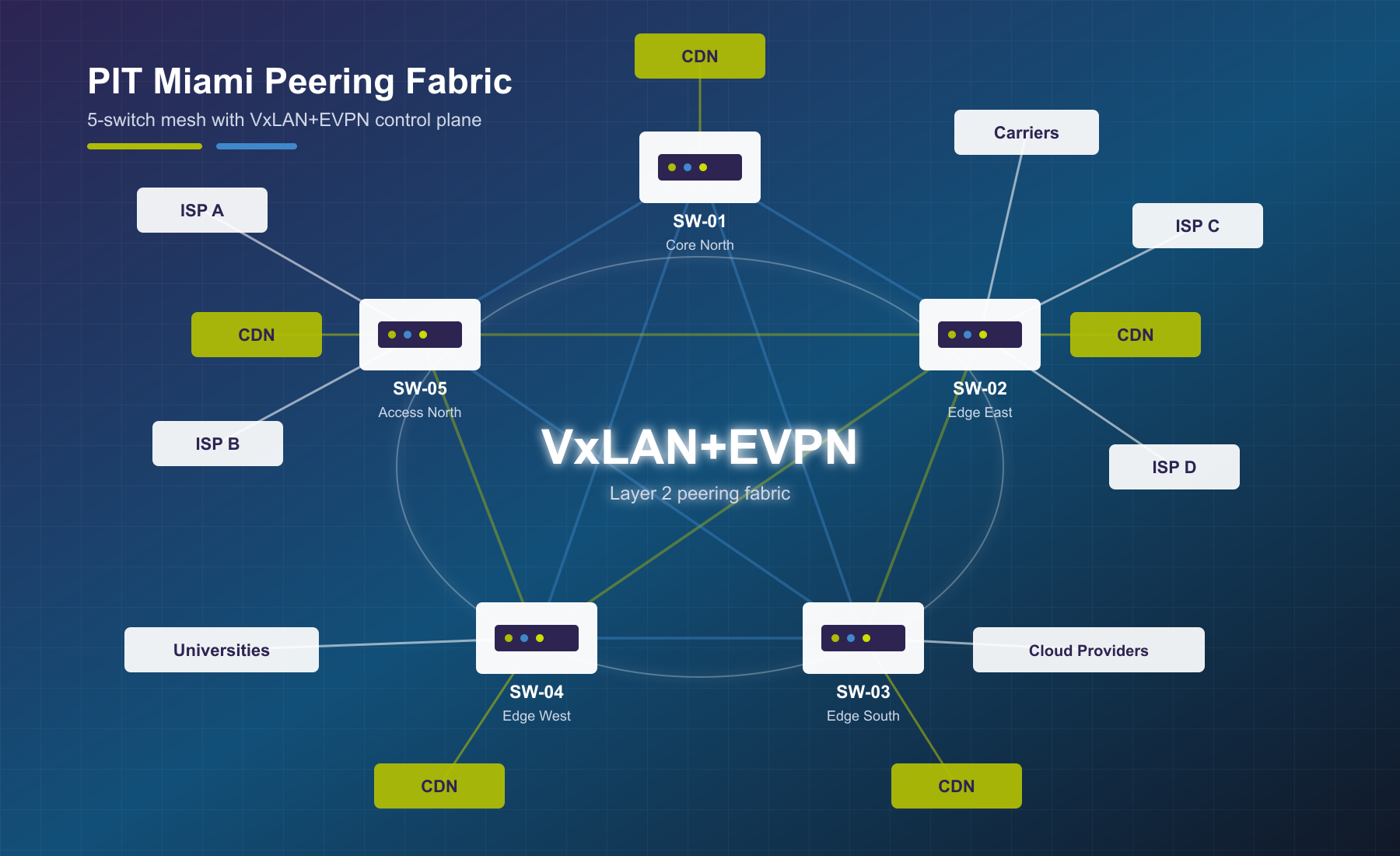
VxLAN+EVPN diagram with five PIT Miami switches in a mesh connected to ISPs, CDNs, carriers, universities and cloud providers

Interface and cabling specifications.

Participant interfaces should use long-reach optical standards aligned with the speed ordered. Final handoff details are confirmed during onboarding.

Port Speed Supported Optics Wavelength Notes
10GE 10GBASE-LR 1310nm Standard 10GE participant handoff.
40GE 40GBASE-LR4 LR4 optical standard Supported for participants requiring 40GE connectivity.
100GE 100GBASE-LR, 100GBASE-LR4 1310nm High-capacity handoff for backbone and content networks.
400GE 400GBASE-LR4 LR4 optical standard Available for high-scale participants and future growth.

Traffic guidelines on the peering LAN.

The peering LAN is reserved for exchange traffic and control traffic required for peering. Participants are expected to keep the fabric stable, predictable and secure.

Allowed Traffic

  • IPv4 and IPv6 unicast traffic exchanged between consenting peers.
  • ARP and IPv6 Neighbor Discovery required for the peering LAN.
  • BGP sessions with bilateral peers and optional route servers.
  • Operational testing traffic coordinated with PIT Miami when needed.

Not Allowed

  • Traffic that disrupts IXP stability, including floods or attacks.
  • Spoofed source addresses, unauthorized prefixes or route leaks.
  • Layer 2 protocols not required for peering, such as STP, LLDP or CDP.
  • DHCP, non-peering multicast, unsolicited broadcast or non-IP payloads.

Operational expectations.

  • Maintain accurate IRR records and use RPKI where available.
  • Announce only authorized, publicly routable prefixes.
  • Keep technical and NOC contacts current for incident response.
  • Coordinate maintenance or unusual testing with PIT Miami operations.